


There's a building tension. Apparent is the frosty air coming from my competitors as they execute the "starting line" jiggle on the start line.
A swift twitch of the hips.
I'm participating in my local 5km community parkrun and I'm focused. It's almost time...
Oh, hang on. I need to adjust my device. As does the runner alongside me.
The person in the line sighs. I won't start until… there! Connection established, I'm off.
In the mele, it's difficult to see a wrist without a fitness tracker on it. And this extends beyond us participants who use them.
This is a booming, multi-billion pound industry. Brands like Apple Watch dominate, all offering an extensive array of diverse versions to suit a range of needs. Depending on how high tech the device you go for, costs can start from a hundred pounds to thousands of pounds.
"It drives me insane, it's impossible to relax."
"It reassures me… It acts as a friend supporting me."
"Please don't notify me about a restless night."
A small sample of the comments I've had from like-minded smartwatch wearers when I inquire what they think of theirs.
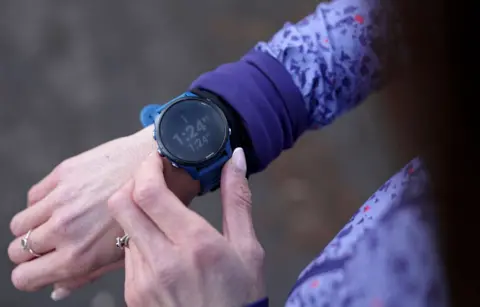
The Monitoring Conundrum
My current opinion on my own device? At this moment, irritating. It's telling me my speed is wrong, making me wonder whether the overhead branches along my route are blocking my satellite signal.
A vast number of us strap these little monitors onto our wrists and use them constantly, apparently unconcerned with the fact they're constantly monitoring us.
Long past are the days when we relied on them only to give us an estimation of our pedometer reading. Today, they can track our sleep patterns, stress levels, oxygen saturation, our VO2 max.
It's a challenge to find a health indicator they fail to monitor.
But can they do what they claim to do? And are the data points we analyse a accurate representation of reality? Do they improve our mental and physical wellbeing, or do the avalanche of measurements and motivational messages just contribute to our sense of overwhelm?

A Love-Hate Relationship
"I find myself getting a a little preoccupied with mine," a wearer reveals.
While she values how her device records her workouts, she finds some of its other functions "overwhelming" at times - a feeling initially realised during a pregnancy.
Until she found out she could adjust the settings, her smartwatch repeatedly informed her she was being insufficiently energetic enough. In a new phase, the watch insists her she's had a restless night.
"I am caring for a young baby, there's no point to be notified my sleep was poor," she says. "I'm acutely aware all too clearly."
Why doesn't she just stop wearing it?
"I could, perhaps, but I've got this love-hate relationship with it," she continues. "I appreciate it for its workout tracking, I just wonder whether the additional features it can now do is maybe excessive for me."
Inside the Device
Every device of smartwatch has its own unique way of measuring your vitals and interpreting your data, but the most use sensors on the back of the watch.
They commonly shine small, green LED lights onto your skin which can monitor blood flow, detecting your pulse rate. More advanced devices measure changes in the electrical current that flows through the skin to get an idea of your nervous system activity.
Expert Perspectives
One expert says that in general for smartwatches, it's a "delicate equilibrium" - while the continuously improving tech could potentially save lives, "detecting disease before we notice anything", it could also turn us watch wearers into the "concerned but fine".
He points out that newer wearables can carry out tests like heart rhythm analysis, which continuously monitor how stable the heart is. They can flag if someone is experiencing atrial fibrillation (AF), where there is abnormal impulses in the heart causing an irregular heartbeat.
This does not necessarily indicate someone is about to have a cardiac event, but it can give an preliminary indication they might be more at risk of a blood clot in the years to come.
But how to understand these figures is complex. The expert concerns that as more functions are added, people may not be able to fully understand their data.
"I remain sceptical that being able to monitor so many metrics is such a good idea," he says.
A health researcher focusing on cardiology agrees. Research into the impact of wearable tech on a specific group of heart condition patients suggested a significant portion of those who were given devices to monitor their cardiac function experienced greater stress and were "more inclined to use medical services".
She noted a cycle with her patients - they noticed a worrying figure on their watch. They became worried. Their pulse rose. They got increasingly anxious. They checked again, and their heart rate rose further.
"Upon viewing stats about ourselves that we can't properly interpret then, of course, we are going to become concerned," the psychologist says. "We look, we check again - it becomes a vicious cycle."


